In this article
The short version
- NAD+ helps every cell turn food into energy and repair everyday damage.
- Studies of human skin and blood show NAD+ levels fall with age.
- An oral NAD+ building block raised NAD+ in blood cells about 60% in 6 weeks.
- In prediabetic women, another building block improved muscle insulin sensitivity by 25%.
- You can raise NAD+ with supplements or prescription shots and sprays, guided by a clinician.
Your cells run on NAD+. It helps turn every meal into energy and powers the repair crews that fix everyday wear and tear. The catch: your levels drop as you get older.
That's why NAD+ has become one of the most talked-about molecules in energy and healthy aging. Here's what it does, the benefits people want, what the studies really show, and the easiest ways to raise it.
What NAD+ is
NAD+ stands for nicotinamide adenine dinucleotide. It's a helper molecule found in every cell, and it's made from forms of vitamin B3.
Think of NAD+ like cash in a register. Every time a cell turns food into energy, NAD+ changes hands. Every time a cell repairs damaged DNA, some gets spent for good. When the register runs low, the whole shop slows down.
You'll also see NR and NMN on supplement labels. Those aren't NAD+ itself. They're building blocks your body converts into NAD+.
Your NAD+ drops with age
This part is well documented in people:
- In skin: A study of samples from 49 people, from newborns to age 77, found NAD+ fell with age in both men and women. DNA damage rose over the same years, along with a repair enzyme that burns through NAD+.
- In blood: In healthy adults aged 20 to 87, older people had lower NAD+ in their blood plasma.
So as the years go by, your cells are doing more repair work with less fuel to spend. That's the case for topping it back up.
The benefits people want from NAD+
People look into NAD+ hoping to:
- Get their energy back, especially the all-day steadiness they had in their 20s.
- Think more clearly, with less brain fog.
- Support a healthy metabolism, including how the body handles blood sugar.
- Age well, by keeping cellular repair running.
Those goals make sense on paper, because NAD+ sits at the center of energy production and repair. The real question is how much topping it up helps in everyday life.
What the research shows
Here's where the science is strongest:
- NAD+ boosters raise NAD+. In a 6-week, placebo-controlled trial of adults aged 55 to 79, 1,000 mg a day of nicotinamide riboside (NR) raised NAD+ in blood cells by about 60%. It was well tolerated.
- One booster improved metabolism. In a 10-week trial of 25 women with prediabetes, 250 mg a day of nicotinamide mononucleotide (NMN) made muscles 25% more responsive to insulin, with no change on placebo.
- IV NAD+ raises blood levels too. In a pilot study, a slow 6-hour IV of 750 mg raised blood NAD+ by 398% by the end, though nothing changed for the first 2 hours.
- Not every result was a win. In the NR trial, fitness and motor function didn't change, and the NMN trial saw no change in weight or blood pressure.
The short version: raising NAD+ works, and early results on metabolism are promising. Big, long-term trials on energy and aging are still to come.
Ways to raise your NAD+
- Oral building blocks. NR and NMN are supplements your body turns into NAD+. They're the most studied option.
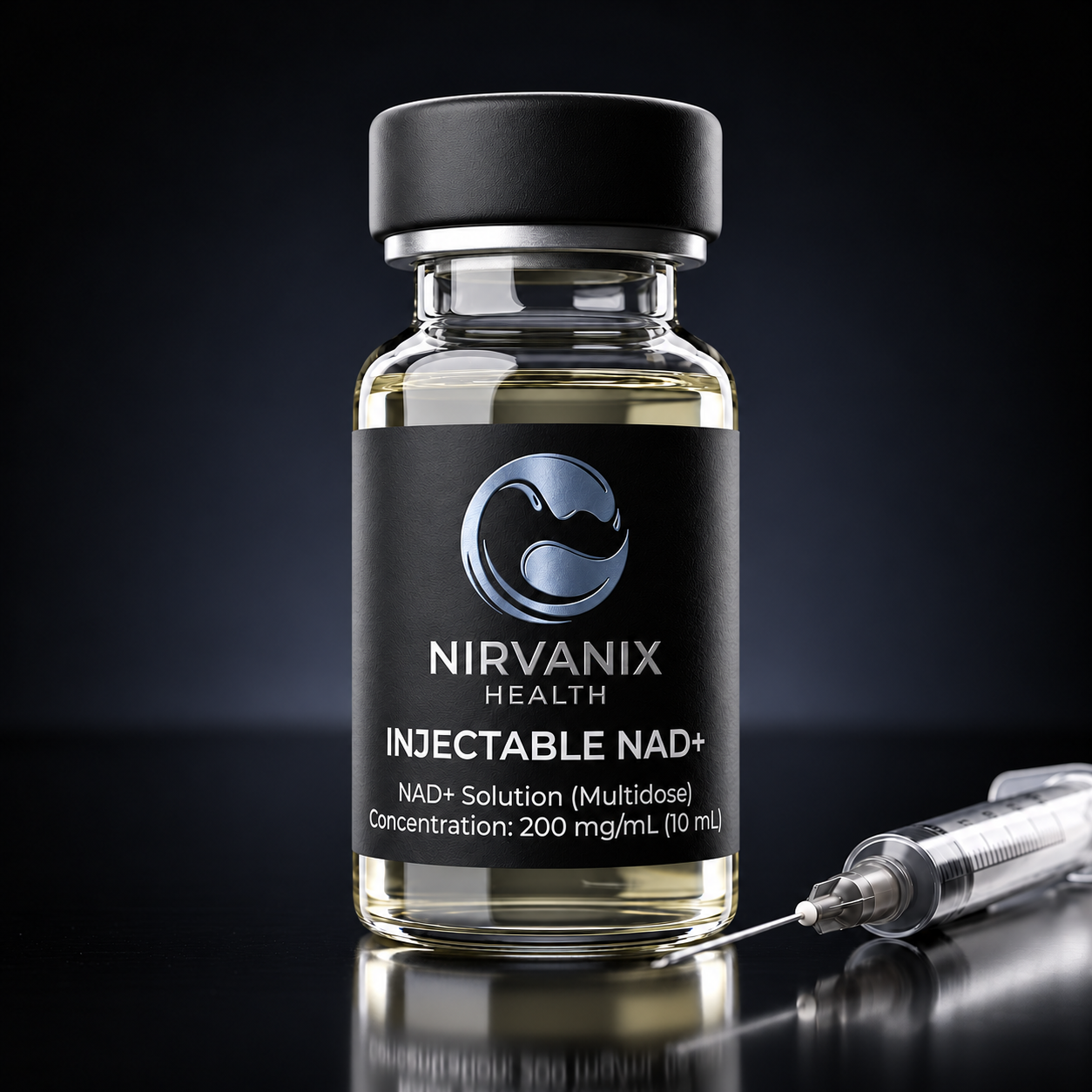
- NAD+ injections. A quick shot at home delivers NAD+ itself, without passing through your gut.
- NAD+ nasal spray. A needle-free option. It's convenient, though it has less research behind it.
- IV drips. These deliver large doses but can take hours, and going too fast can cause cramping or nausea.
- The basics. NAD+ works inside cells that also need sleep, movement, and good food. No booster replaces those.
Side effects and safety
- Supplements: In the 6-week NR trial, side effects were mild and no more common than on placebo.
- Injections: Expect possible soreness, redness, or a small bump where the needle went in.
- IV drips: When NAD+ goes in too fast, people can feel stomach cramping, nausea, or chest pressure, which eases when the drip slows or stops.
How Nirvanix does NAD+
A Nirvanix clinician reviews your health history and goals, then decides whether NAD+ fits and which form makes sense. If it's prescribed, a licensed pharmacy prepares it and ships it to you. Your clinician sets your dose and can adjust your plan, and the consultation is included. Working on weight too? Accelerate & Thrive pairs tirzepatide with NAD+.
The bottom line
NAD+ helps your cells make energy and repair damage, and your levels fall with age. Oral boosters reliably raise NAD+, and one improved how muscles handle sugar, while big trials on energy and aging are still underway. A clinician can help you pick the right way to raise yours.
Want to see if NAD+ fits your goals? Take the two-minute quiz.
Common questions
What are the benefits of NAD+?
NAD+ helps your cells make energy and repair damage, so people use it hoping for more energy, sharper focus, better metabolism, and healthy aging. Studies show NAD+ boosters reliably raise NAD+ levels, and one improved muscle insulin sensitivity by 25% in women with prediabetes. Large trials on energy and aging are still underway.
Does NAD+ really decline with age?
Yes. Studies of human skin found NAD+ levels fell with age in both men and women, and blood studies found lower levels in older adults. There's no single age when it happens, which is why people start looking at NAD+ at different points in life.
Is NAD+ the same as NMN or NR?
No. NMN (nicotinamide mononucleotide) and NR (nicotinamide riboside) are building blocks your body turns into NAD+. They're sold as supplements. NAD+ itself is usually given by injection, IV, or nasal spray with a prescription.
How can I raise my NAD+ levels?
Oral building blocks like NR and NMN have been shown to raise NAD+ in studies. Prescription NAD+ injections and nasal sprays deliver NAD+ itself. A clinician can help you choose the right option for your goals.
Is NAD+ safe?
In a 6-week trial, the NAD+ building block NR was well tolerated with no serious side effects. NAD+ shots can cause soreness where the needle goes in, and NAD+ given by IV too fast can cause cramping or nausea. Your clinician will review your health history first.